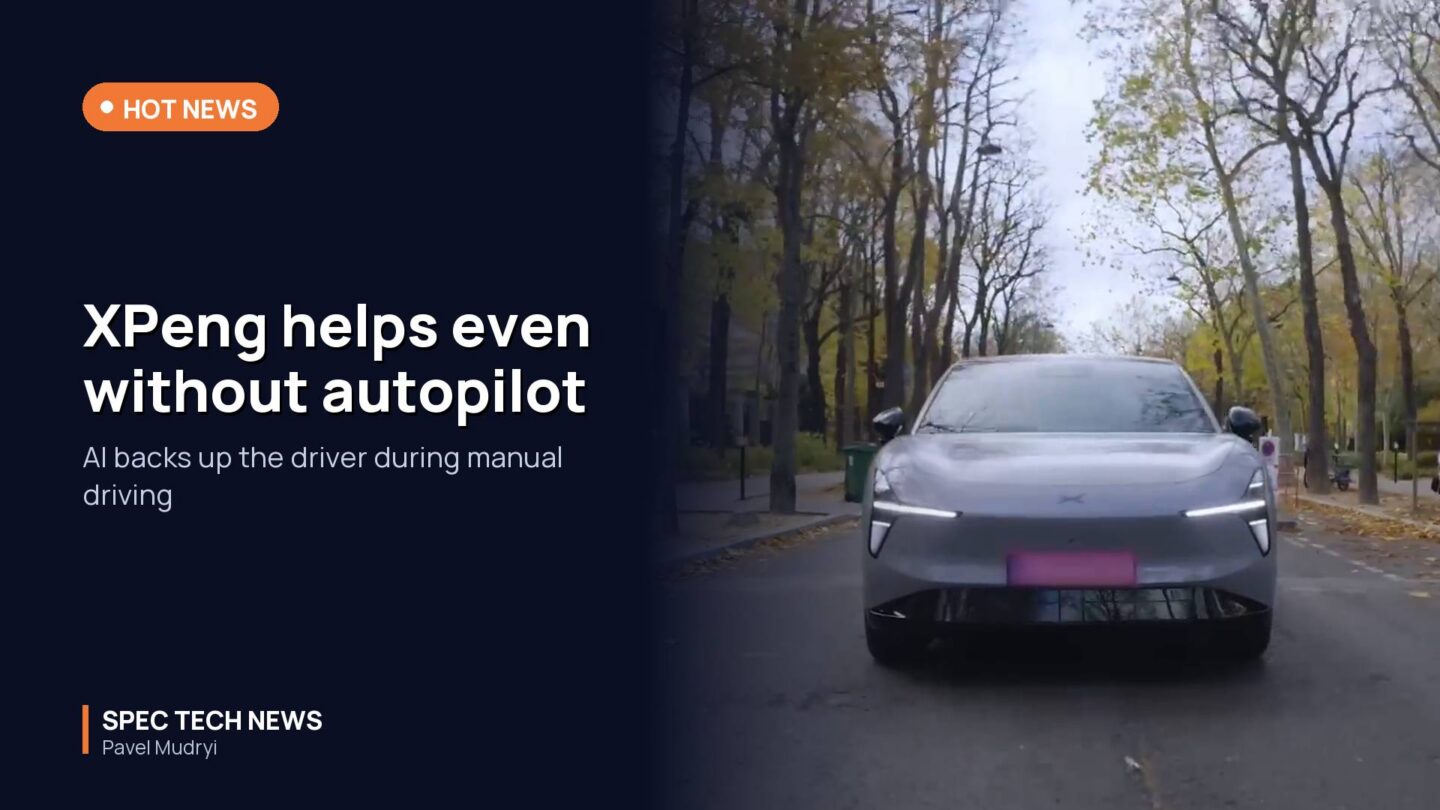
XPeng unveiled Turing AI Co-Driving at its AI Day on November 25. It can assist with speed and steering while the driver is in control. The first feature, adaptive regenerative braking, will roll out over the air in China in December. XPeng hasn’t announced European availability.
Driver assistance usually means the car drives while a person supervises. XPeng is proposing the reverse: the person drives and the AI backs them up.
What happened
- XPeng held AI Day 2026 in Guangzhou on November 25. Turing AI Co-Driving uses X-VMC 2.0 to coordinate power delivery, braking, steering and suspension. The idea is for AI to help throughout the drive, including when automated driving is switched off.
- The first feature, VLA Adaptive Deceleration, looks at the road ahead when the driver lifts off the accelerator and adjusts the strength of regenerative braking.
- XPeng says its tests found that drivers in traffic pressed the brake pedal 95% less often. It also claims a 12.4% increase in range in urban traffic compared with driving with regeneration disabled.
- An over-the-air update is due in China in December for Ultra versions of the G9L and Mona L05. Other models with Turing chips are due to follow from the second quarter of 2027. XPeng is also developing AEX, a system designed to actively avoid collisions from any direction.
- XPeng also said it would sell its driving assistant as a subscription to new buyers from the second quarter of 2027. People who order ahead of that date keep their access for life.
What it means
Tesla emphasizes FSD (Supervised), where the system drives while a person supervises. XPeng’s Co-Driving approach has the human drive while the AI helps. XPeng supplied the efficiency figures and there are no independent tests yet.
Fully driverless operations are only starting to emerge. Tesla was still testing robotaxis with an onboard supervisor over the summer, and the US regulator NHTSA is following its driverless launch. With Co-Driving, the driver remains responsible.
Pavel’s take
XPeng calls it Co-Driving, and my first question is how long Tesla has had anything similar. That’s a bigger question than it sounds. We still haven’t reached the point where a driver is unnecessary everywhere. Even Tesla’s robotaxis still depend on human oversight in many cases. XPeng’s results show what AI built into a car can do.
You can drive yourself and still drive inefficiently. An AI assistant could use less fuel or electricity, help prevent mistakes and perhaps reduce crashes, at least at lower speeds. The technology keeps moving while we wait for fully autonomous driving.
Frequently asked questions
Will Co-Driving come to Europe?
XPeng hasn’t said. The first feature is due in China in December for the G9L and Mona L05.
Is this an autopilot?
The driver controls the car while the AI helps with braking and, later, steering. The driver remains responsible.
Will I have to pay?
Turing AI driver assistance becomes a subscription for new buyers in the second quarter of 2027. XPeng hasn’t said whether Co-Driving will be included.