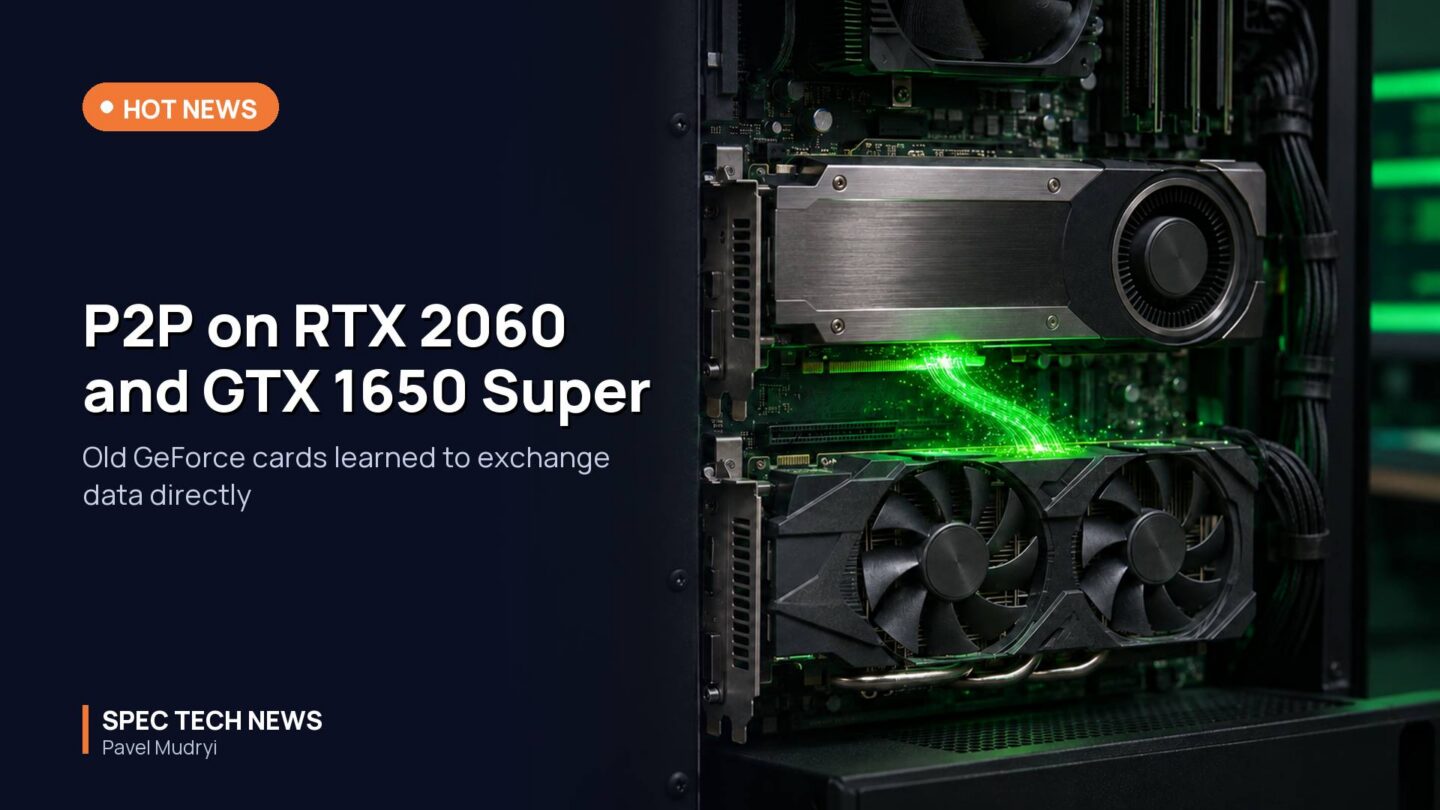
A Linux experiment enabled direct transfers between an RTX 2060 and a GTX 1650 Super. Developer Kamil Skowron reports up to 78% faster transfers and one-twentieth the latency on his test system. Independent results are still pending.
What happened
GeForce RTX 20 and GTX 16 cards expose a 256 MB window into VRAM to the CPU and other GPUs. Skowron expanded the window to cover the cards’ full memory and enabled peer-to-peer transfers with a modified NVIDIA open kernel driver on Ubuntu 26.04. The setup leaves the card firmware intact. It disables the onboard USB-C and UCSI controllers, and the BAR1 resize has to be reapplied after a reboot.
His test paired a 6 GB EVGA RTX 2060 (TU104) in a B550 chipset PCIe 3.0 ×4 slot with a 4 GB MSI GTX 1650 Super (TU116) in a CPU-connected ×16 slot. Skowron says the results were comparable to his two RTX 3080s in the same slots. His project notes also document an experimental RTX 2060 and RTX 3060 pairing; there are no results here for RTX 40 and 50 cards.
What it means
P2P helps GPUs exchange parts of a model more efficiently in workloads such as PyTorch or vLLM. Two 16 GB cards can run a model split across them even without P2P. Each still has its own memory, and cross-GPU transfers can limit performance. That is where lower latency can help.
My take
I can’t wait to put two 16 GB RTX 5060 Ti cards in my PC and give my little AI models some room to run. If this could work on those cards and the extra memory came with a corresponding speed boost, that would be fantastic for people who can’t stretch to a 24 GB or 32 GB GPU.
Will it work on Windows or boost my frame rate?
The experiment uses a patched Linux driver and targets multi-GPU compute. There is no evidence of a gaming gain. The developer warns that the experimental driver can freeze the system or corrupt data in VRAM.