

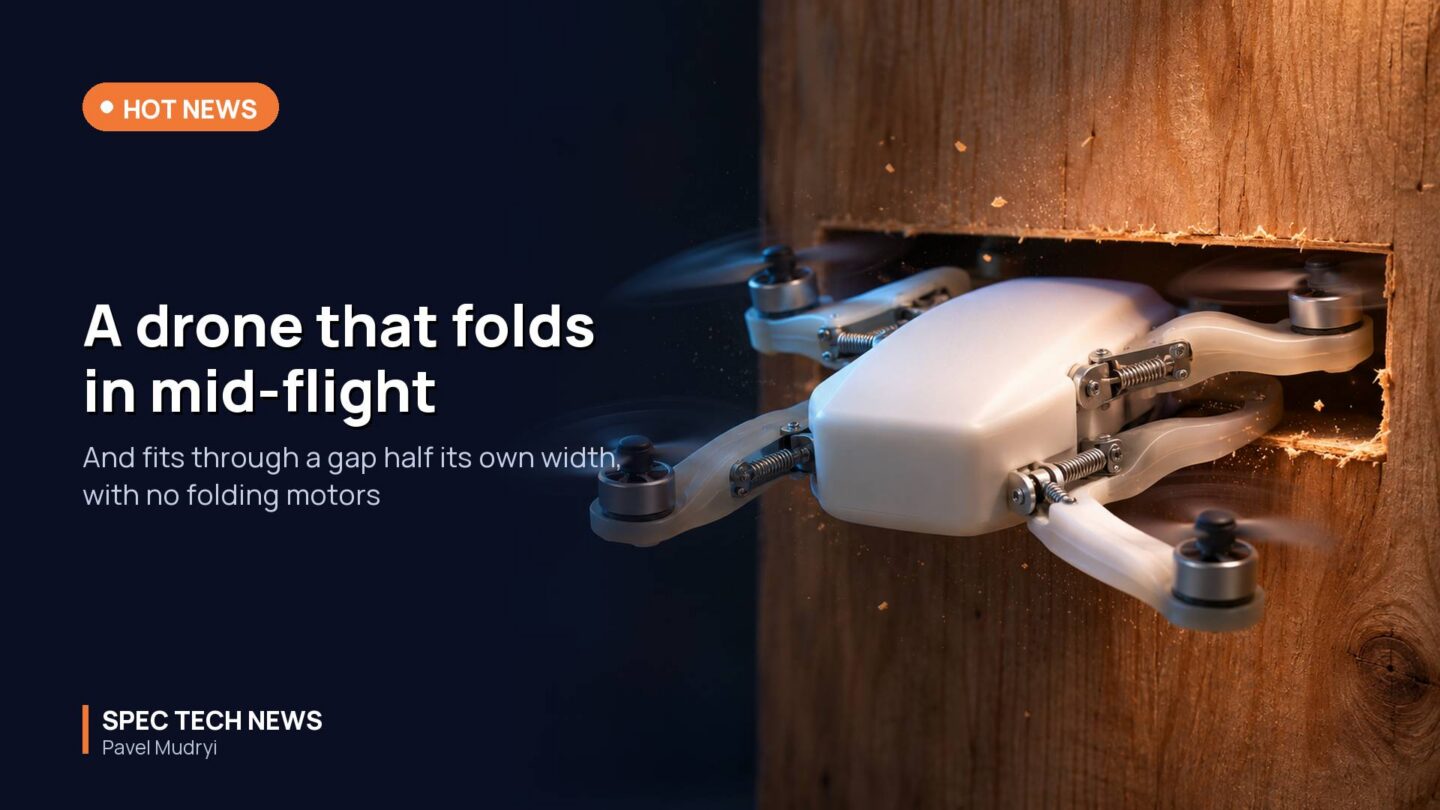
Researchers tested a 31.3 cm quadrotor that folds on contact and flies through a 15 cm opening. Its arms spring open again after it clears the gap.
What happened
The NTNU and ETH Zurich-led research uses passive, spring-loaded joints. The arms fold back as they touch the edge of an opening and the drone narrows to 14.1 cm. The team reported flights through a 15 × 20 cm opening and a 40 cm tube. In more oblique approaches, an arm sometimes dislodged. Normal flight used less than 1% more energy than the rigid comparison design in the reported tests.
Why it matters
A shape-changing frame could be useful for inspection and search-and-rescue in spaces that are hard to reach. The work is a laboratory prototype described in a preprint. The results do not establish performance in debris or prolonged field use.
Pavel’s take
Pavel sees a plausible future for this idea in rescue work and specialist inspections, where access can matter more than range.
What readers ask
Does the drone need a motor to fold its arms?
The frame folds passively on contact. Springs bring the arms back after it passes through.