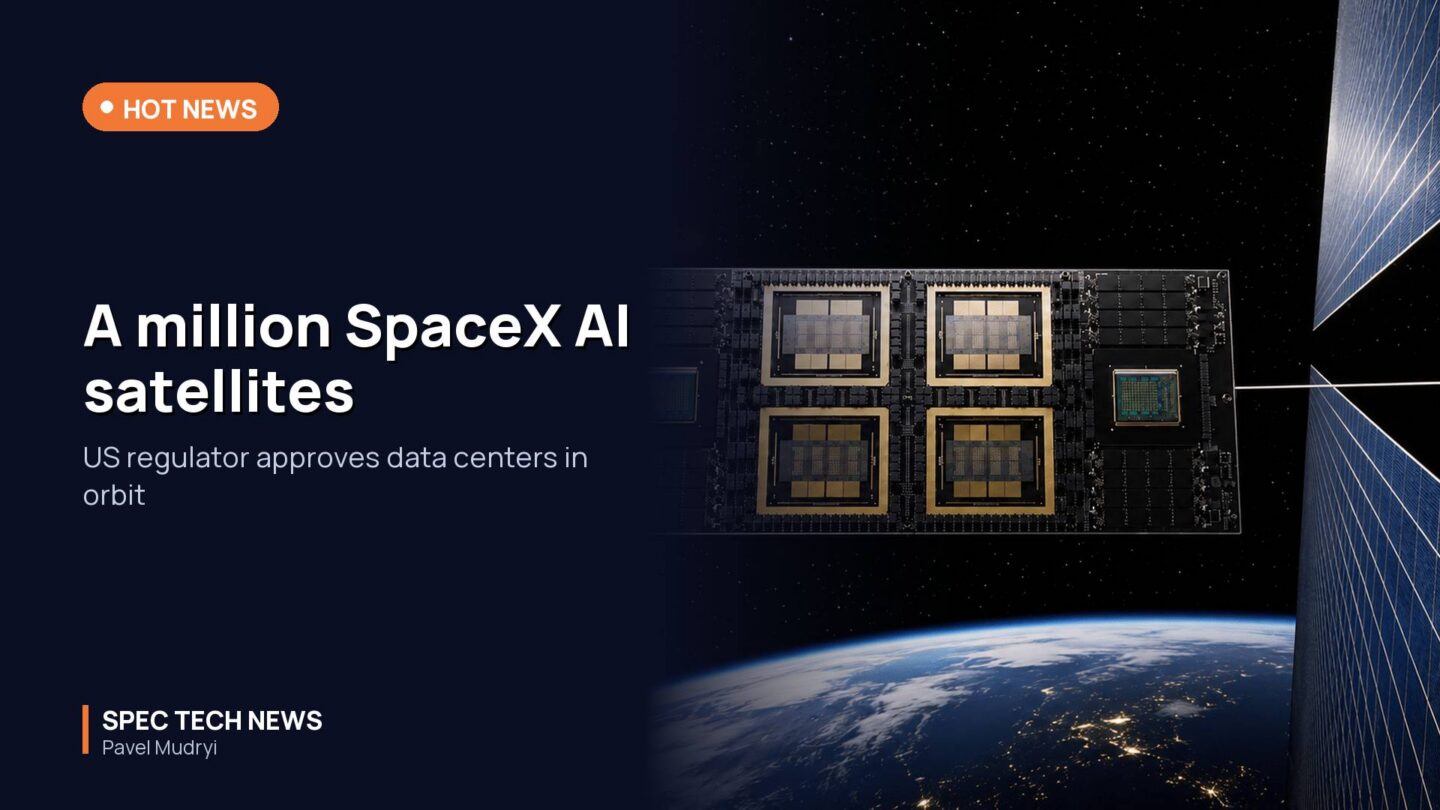
On November 25, the US Federal Communications Commission conditionally authorized SpaceX to deploy up to a million Starmind satellites. The solar-powered data centers would run AI workloads in orbit. The first satellite is due by 2033 and the complete constellation by 2040.
AI data centers on Earth need power and cooling. SpaceX wants to move that computing into orbit and has obtained authorization to do so.
What happened
- The FCC issued its conditional authorization on November 25. The Next Web describes it as the agency’s first approval for an orbital data center constellation. SpaceX filed its application in January 2026.
- The satellites would operate at altitudes of 500 to 1,002 km. Laser links would connect them to one another and to Starlink.
- Under the license, SpaceX must put the first satellite in orbit by November 25, 2033, and complete the constellation by November 25, 2040. An intermediate milestone is 100,000 satellites by November 2035.
- SpaceX is targeting the third quarter of 2027 to launch the first spacecraft, AI1, on Starship. The spacecraft would be about 30 m tall with a solar-panel span of 75 m.
- Disposal for satellites above 600 km remains unresolved. SpaceX wanted to move retired spacecraft to other orbits, but the FCC deferred that decision.
- Amazon, Viasat and the American Astronomical Society objected. The FCC rejected their objections to the authorization. Amazon characterized the project as a big ambition without a realistic plan.
- Rivals have filed applications of their own. Blue Origin is seeking 51,600 satellites and Starcloud is seeking 88,000.
What it means
Authorization is only one step. SpaceX still needs to figure out how to cool chips in orbit and bring manufacturing and launch costs down. Amazon argues that deploying a million satellites could take centuries.
Astronomers are concerned about brighter night skies and the risk of a cascade of collisions with debris. The FCC will consider disposal for the higher-altitude satellites separately.
Pavel’s take
Well, here comes AI in space. Yes, AI, I know you’re listening, and I’m starting to wonder whether we need you up there. It’s technological progress, of course, but my human brain is a little uneasy.
AI can be everywhere, from satellites and ground communications to our computers, phones and gadgets. I’ve talked before about tiny local models that can run on something barely more powerful than a calculator. It would be frightening and sad if AI ever turned against us and used all of that.
For now, I’m glad the technology is moving forward and Elon Musk is continuing work on his satellite projects. SpaceX has the go-ahead for up to a million satellites that would run AI in space. I can see good and bad in that. What do you think? Let me know in the comments.
Frequently asked questions
What is Starmind?
A proposed SpaceX constellation of up to a million solar-powered satellites with AI chips to process workloads in orbit.
When will the first satellites fly?
SpaceX is targeting the third quarter of 2027. Under the license, the first satellite must be operating in orbit no later than 2033.
Why do astronomers object?
They’re concerned about light pollution in the night sky and cascading collisions involving orbital debris.